
Fifty-four percent of US citizens believe that American economic inequality today is a major problem, and 79% believe it is a problem, according to a Harris Poll. Public opinion regarding American economic inequality has not changed much in the last two years, with 80% believing it was a problem in 2012.
Opinions differ according to people’s political inclinations. Just 36% of those identifying themselves as Republicans see it as a major problem, compared to 70% of Democrats and 55% of Independents.
The Harris Poll included 2,234 American adults whose opinions were expressed online between March 12th and 17th.
Household income linked to perception of inequality
Unsurprisingly, the survey revealed an association between household income and people’s opinions regarding how serious inequality is in the US. A lower percentage of households earning more than $100,000 per year see inequality as a major problem than those making less than $75,000.
Below is a percentage of households that saw American economic inequality as a major problem according to annual income:
- Income under $35k: 59%
- Income between $35,000 and $49,999: 61%
- Income between $50,000 and $74,999: 59%
- Income $100,000 or more: 45%.
Regarding the nature of the American economic inequality, 59% see it as a moral issue while 72% see it as a political one.
A political issue – most people across the political spectrum believe inequality is a political issue – 82% of Democrats, 60% of Republicans and 72% of Independents.
A moral issue – many more Democrats (73%) see inequality as a moral issue, compared to 43% of Republicans and 55% of Independents.
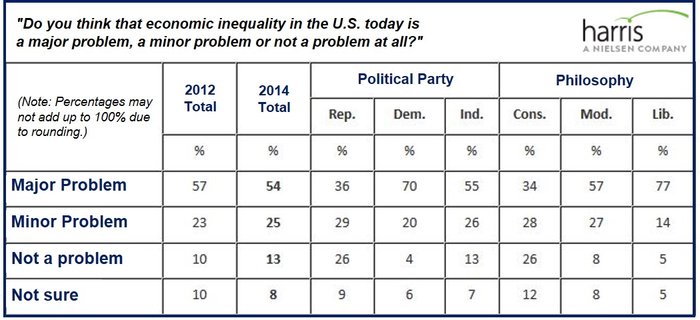
(Source: The Harris Poll)
American economic inequality – what should the government do?
Today, 66% of Americans believe the government should introduce policies that address inequality across the country, compared to 62% in 2012. Forty percent today identify it as very important compared to 34% two years ago.
Among Democrats, 86% think such action is important and 60% say it is very important, compared to 43% and 18% of Republicans respectively. Independents fall between the two parties, with 65% saying it is important and 37% very important.
Younger people are more likely to view such government action as important compared to older people:
- Millennials (born since early 1980s): 76%
- Gen Xers (born early 1960s to early 1980s): 68%
- Baby boomers (born between 1946 and 1964): 64%
- Matures (born before 1946): 50%
Causes of inequality in the US
Below are factors that people consider contributed to American economic inequality today:
- Loss of manufacturing jobs to India, China and other low cost nations: 83%
- The tax system: 81%
- Government policies being influenced by big business: 80%
- Government policies being influenced by super-rich people: 78%
- Poor education in public schools: 75%
- The globalization of the world economy: 67%
- Restrictions that prevent businesses from creating more employment: 66%
- The current minimum wage: 65%
The proportions listed above are similar to those found in the 2012 poll, with a greater percentage today seeing the tax system as a contributory factor (77% in 2012).
Even though most Americans agree that the super-rich influence government in a way that exacerbates economic inequality, 47% say that they have become scapegoats for the country’s problems versus 53% who disagree. Sixty-eight percent of Republican voters believe the very rich are being used as scapegoats versus 33% of Democrats and 46% of Independents.
Which party can best address inequality?
When asked which political party is likely to do a better job at dealing with issues of unfairness and inequality, 35% of all Americans pointed to the Democratic party and 21% to the Republicans, while 7% chose another party. Twenty-three percent say neither party and 14% were uncertain.
Seventy-three percent of Democrats believe their own party would do a better job compared to 61% of Republicans. Thirty-five percent of Independents believe neither party would do a good job, 25% picked the Democratic and 10% the Republican party.
American inequality growing – researchers from the University of Oxford, the Paris School of Economics and the University of California, Berkeley, reported that the difference in income between the richest 1% and the other 99% in the US was higher than ever.
