
Politicians in Western Europe and the US as well as economists are wondering whether a Sino-Russian natural gas deal is about to be signed as Russian President Vladimir Putin’s state visit to China draws closer.
If they do sign, Russia’s position in the face of growing economic sanctions from the West will be much stronger. Russia earns approximately $100 million dollars per day from the sale of natural gas to European nations. Losing that income, which represents nearly 3% of the country’s economic output, is not in Russia’s best interests.
Natural gas traders in Europe are betting that the Russian economy cannot afford to lose that income if the Ukrainian crisis escalates. They do not believe Russia would dare cut gas supplies to its European customers.
In Europe’s biggest natural gas market, the UK, next-month-gas declined 19% since Russia occupied Crimea in February. Last week, prices dropped to their lowest point since 2010.
According to IHS Inc., an escalation of the conflict with Ukraine would come with a $115 billion bill for Russia in 2015.
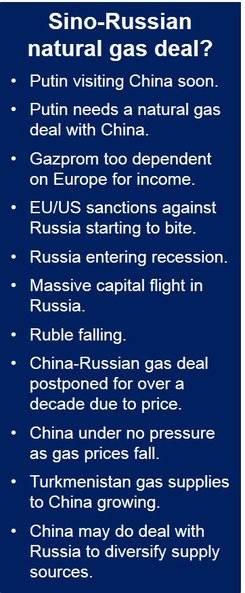
According to the International Monetary Fund, Russia is entering a recession. Jittery investors are moving tens of billions of dollars out of Moscow, and the ruble slides further each month.
In April, Russia’s S&P rating was downgraded to BBB- from BBB, which is just above “junk” status. Anton Siluanov, Russia’s Finance Minister, is predicting zero economic growth for 2014 because of the Ukrainian crisis.
Gazprom heavily dependent on Europe
Gazprom generates about four-fifths of its income from natural gas sales to Europe. So far, it has failed to gain a strong foothold in Asia because of its comparatively small liquefied natural gas (LNG) business and lack of pipelines that go eastward.
Amid tensions with Western nations, particularly the European Union and the US, Putin may well come home from his China visit with a deal, and Russia’s growing economic dependence on the EU would be reduced.
Sino-Russian natural gas deal ten years in the making
Whether or not the two countries have agreed on a mutually acceptable price is anybody’s guess. For the last ten years the meat and bones of a deal have been there on the table for both to sign; the only sticking point has been the price.
After the annexation of Crimea and the continuing problems with the US and EU regarding Ukraine, China is in a much stronger bargaining position and may well demand a better price, analysts say.
Of course, Russia flatly denies that China is trying to use the Ukraine crisis and threats of further US/EU sanctions to knock down the price of Russian natural gas. In fact, Interfax, Russia’s news agency, quoted a CNPC (China National Petroleum Corporation) official who said that the heads of Gazprom and CNPC reached an agreement to sign a contract during Putin’s state visit.
Why has it taken so long?
CNPC and Gazprom have been negotiating for more than ten years about a deal involving 38 billion cubic meters (bcm) or $15 billions’ worth of gas each year.
Nothing has been signed so far because the two countries have been unable to agree on:
- Price.
- Whether or how China may develop fields in Russia.
- Russia allegedly wants a huge down-payment worth billions of dollars.
Competition from Turkmenistan
Reuters quoted sources in Beijing who said that China believes that growing North American natural gas exports will result in lower prices. They add that Turkmenistan is becoming a reliable and growing supplier of natural gas to China. These plus other factors place China under no pressure to sign a deal with Russia.
Approximately half of all China’s natural gas imports – about 20 bcm – comes from Turkmenistan. The two countries are committed to increasing the supplies to 65 bcm by the end of the decade.
Turkmen President Gurbanguly Berdymukhamedov recently met with Chinese President Xi Jinping during a state visit to China – the two leaders pledged closer cooperation, especially regarding the supply of energy.
Gazprom has some things going for it:
- China, which has a serious pollution problem, wants to switch from burning coal to natural gas, so its consumption of gas is going to increase significantly.
- Russia’s geographical position is ideal for supplying parts of China with large population centers.
- Nobody likes to become over-reliant on a single supplier.
